
Dental Implants vs Bridges: Which Is the Right Choice for You?

When you lose a tooth, two options come up in almost every dental conversation: a dental implant or a dental bridge. Both replace the visible gap. Both restore chewing function. Both can look completely natural. But they work very differently, have different long-term outcomes, and suit different patients.

This guide cuts through the noise and gives you a clear, clinical comparison — so you can walk into your consultation at K-Dental in Karvenagar, Pune already knowing the right questions to ask.

The Core Difference: What Each Option Actually Does

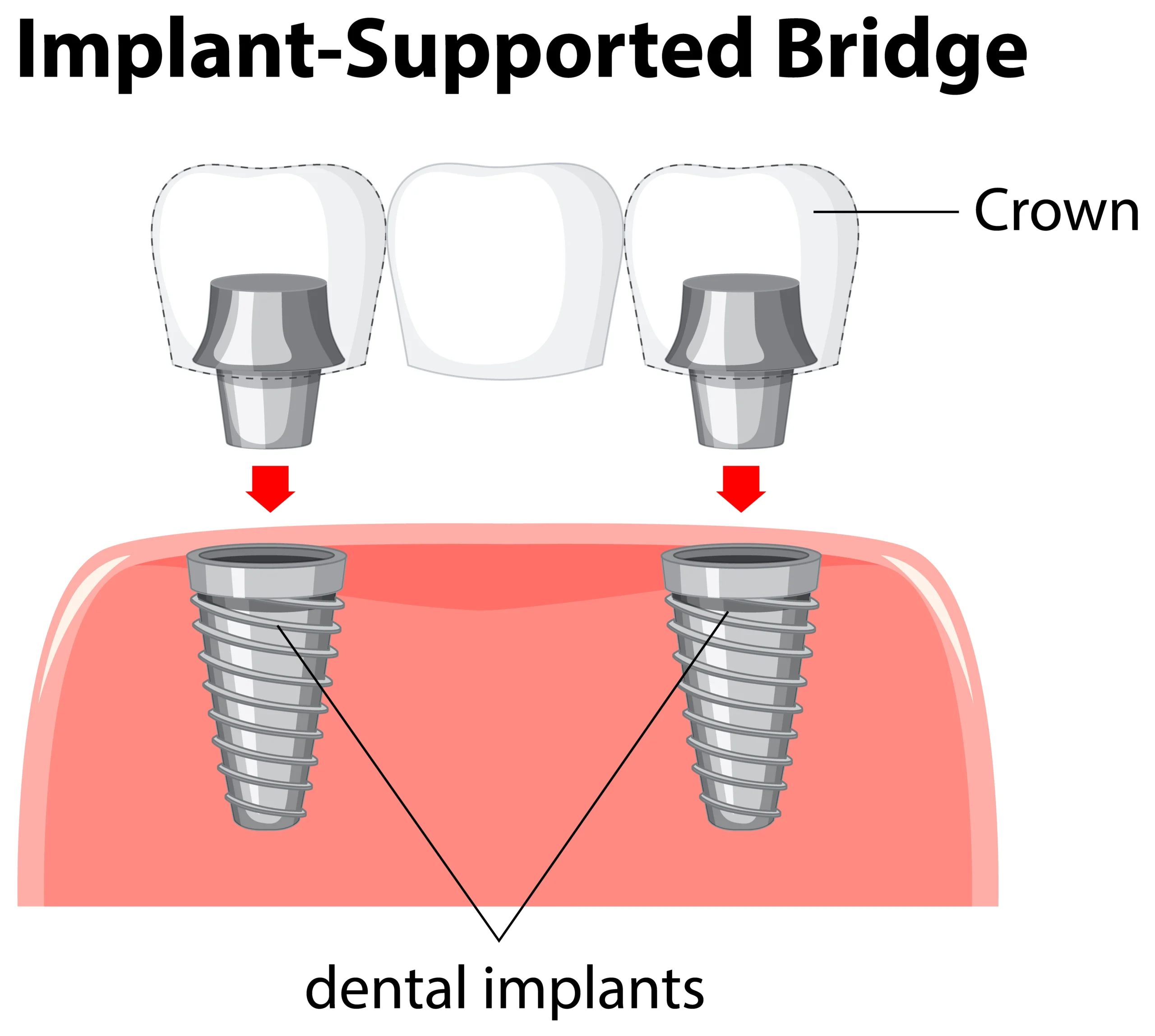
A dental bridge is a fixed prosthetic that spans the gap left by a missing tooth. It uses the two teeth on either side of the gap (called abutment teeth) as anchors. These adjacent teeth are permanently ground down to support crowns, and a false tooth (pontic) hangs between them.

A dental implant replaces the missing tooth root entirely. A titanium post is surgically placed into the jawbone, where it fuses with the bone through osseointegration over 3–6 months. A ceramic or zirconia crown is then attached on top — a standalone, independent tooth that doesn’t involve adjacent teeth at all.

That single distinction — root replacement vs crown-level replacement — is the reason most long-term evidence favours implants.

Dental Implants vs Bridges: Side-by-Side Comparison

Factor Dental Implant Dental Bridge
Procedure type Surgical (implant + crown) Non-surgical (crown prep + pontic)
Adjacent teeth affected None Yes — permanently altered
Bone preservation Yes — stimulates jawbone No — bone resorption continues
Lifespan 15–25+ years 8–15 years
10-year clinical survival ~95% 70–85%
Maintenance Brush and floss normally Requires floss threader under bridge
Timeline to completion 3–6 months 2–3 weeks
Cost (India, per unit) ₹25,000–₹55,000 ₹10,000–₹30,000 (3-unit bridge)
Bone graft needed? Sometimes Never
Reversible? No No

When a Dental Implant Is the Better Choice

An implant is clinically the stronger long-term solution in most scenarios. It is the preferred option when:

  • Adjacent teeth are healthy. Grinding down two sound teeth to support a bridge is an irreversible procedure — one that permanently weakens healthy tooth structure. An implant leaves them completely untouched.
  • You want a long-term investment. With proper care, a well-placed implant can last a lifetime. A bridge typically needs replacement at the 10–15 year mark, which adds to the lifetime cost.
  • Bone preservation matters. Once a tooth is lost, the jawbone at that site begins to resorb (shrink). An implant is the only tooth replacement option that stops this process — because the titanium root actively stimulates the bone, just like a natural tooth root does.
  • You are under 50 with good bone health. Younger patients who choose a bridge will likely face at least one replacement — and potentially compromised abutment teeth — over their lifetime.

When a Dental Bridge May Be More Appropriate

A bridge is a legitimate and well-established treatment with clear advantages in specific clinical situations:

  • The adjacent teeth already need crowns. If the teeth on either side of the gap are already heavily restored or decayed, they may need crowns regardless. In that case, a bridge combines three procedures efficiently.
  • Bone volume is insufficient. If significant bone loss has occurred and the patient is not a candidate for bone grafting, an implant may not be feasible. A bridge restores function without surgery.
  • Budget constraints in the short term. The upfront cost of a dental bridge in Pune is lower than an implant. For patients with financial constraints, a well-made bridge is a solid interim or long-term solution.
  • Medical contraindications to surgery. Uncontrolled diabetes, certain medications, or a history of radiation therapy to the jaw can affect implant candidacy. A bridge requires no surgery.

The Cost Question: Is the Implant Worth the Higher Upfront Cost?

The dental bridge vs implant cost comparison in India often tips patients toward bridges initially. But the math changes over time:

  • A 3-unit bridge in Pune typically costs ₹10,000–₹30,000, depending on material.
  • A dental implant in Pune costs ₹25,000–₹55,000 for a single tooth.

Over 20 years, a bridge may need replacement once or twice — each time requiring further work on the abutment teeth. The cumulative cost of a bridge, plus the long-term bone loss it doesn’t prevent, often makes the implant the more economical option over a patient’s lifetime.

This is not universal — it depends on your age, bone health, and clinical picture. A proper evaluation will give you a realistic long-term cost scenario for both options.

What Dentists Actually Recommend in 2026

The clinical consensus in 2026 is clear: for most patients replacing a single missing tooth, <strong>a dental implant is the preferred option</strong> where bone and health allow. Adoption of single-tooth implants over bridges rose 22% year-on-year in India in 2025, driven by growing patient awareness and improved affordability of non-premium implant systems.

Bridges remain an important treatment — they are not obsolete — but they are most appropriate when implants are not feasible, not simply as a default cheaper option.

At K-Dental, Karvenagar Pune, Dr. Gaurav Ketkar evaluates every missing tooth case individually. You will receive a clinical recommendation based on your bone density, adjacent tooth health, medical history, and budget — not a one-size answer.

Explore our Dental Implants and General Dentistry service pages to understand what each treatment involves, or visit our Cosmetic Dentistry page if aesthetics are a primary concern alongside function.

Book a consultation at K-Dental →

Frequently Asked Questions

Q1. Which is better — a dental implant or a bridge?

For most patients with healthy adjacent teeth and adequate bone, a dental implant is the better long-term option. It preserves bone, doesn’t affect neighbouring teeth, and lasts significantly longer.

Q2. Is a dental bridge permanent?

A bridge is fixed (not removable), but it is not permanent — it typically needs replacement after 10–15 years. The alteration made to the abutment teeth is permanent.

Q3. Can I get an implant instead of a bridge years later?

Sometimes, yes — but bone loss that occurred in the gap over those years may require bone grafting before an implant is possible. Early intervention is always better.

Q4. Does getting a dental implant hurt?

The procedure is done under local anaesthesia. Most patients describe mild soreness for a couple of days post-surgery, easily managed with standard pain relief.

Q5. How long does a dental bridge last in India?

A well-maintained bridge typically lasts 10–15 years. The longevity depends on the materials used, the health of the abutment teeth, and how well the patient maintains oral hygiene.

Q6. What is the cost difference between an implant and a bridge in Pune?

A 3-unit dental bridge in Pune costs approximately ₹10,000–₹30,000. A single tooth implant (implant + crown) costs ₹25,000–₹55,000. Over a lifetime, the total cost of ownership often favours the implant.

Q7. Do dental implants look and feel natural?

Yes. Once fully restored, an implant is indistinguishable from a natural tooth in appearance, feel, and function.

Citations & Sources

  1. 10-year implant survival rate (~95%) and bridge survival (70–85%): goldcoastdental.com — February 2026
  2. Adoption of implants over bridges rising 22% YoY in India (2025 data): globenewswire.com — January 2026
  3. Implants vs bridges long-term comparison India context: onedentall.com — February 2026
  4. Bridge lifespan 8–12 years, implant as gold standard: neodentalcare.in — April 2026
Full Mouth Rehabilitation: Who Needs It and What Does It Involve?

Most dental visits address one problem at a time — a cavity here, a crown there. But some patients walk in with a combination of issues so interrelated that treating them individually, one by one, would be both inefficient and incomplete. That’s exactly what full mouth rehabilitation is designed for.

If you have been told you need “a lot of work done” — or if you’re dealing with worn-down teeth, missing teeth, gum disease, and jaw pain all at once — this guide explains what the treatment actually involves, who it’s for, and what to realistically expect at a clinic like K-Dental in Karvenagar, Pune.

What Is Full Mouth Rehabilitation?

Full mouth rehabilitation — also called full mouth reconstruction or full mouth restoration — is a comprehensive, planned course of dental treatment that addresses every functional and structural problem in the mouth in a coordinated way.

It is not a single procedure. It is a treatment plan that may bring together dental implants, crowns, bridges, gum treatments, bite correction, root canal treatment, and cosmetic dentistry — all sequenced in the right clinical order to restore both full function and a natural appearance.

It’s worth distinguishing this from a smile makeover. A smile makeover is cosmetically driven — improving how teeth look when they are otherwise structurally sound. Full mouth rehabilitation is clinically driven — health and function come first, with aesthetics integrated into the outcome, not the other way around.

Who Needs Full Mouth Rehabilitation?

Not everyone with dental problems needs a full rehabilitation. The treatment is typically recommended when multiple systems of the mouth — teeth, gums, bite, jaw — are compromised at the same time. Common candidates include patients with:

Severe tooth wear Grinding (bruxism), acid reflux, or years of acidic food and drink can erode enamel to the point where teeth are significantly shortened, sensitive, and structurally weak. When more than a few teeth are affected, individual restorations don’t solve the underlying bite problem — the entire occlusion (bite) needs to be rebuilt.

Multiple missing teeth Losing several teeth — whether due to decay, trauma, or gum disease — changes how the remaining teeth load, drift, and wear. This creates a cascade effect that worsens over time. Dental implants, bridges, or implant-supported prosthetics are planned as part of a broader rehabilitation, not in isolation.

Advanced gum disease Untreated periodontitis destroys the bone that supports teeth. Before any restorative work can be placed, the infection must be controlled and the gum health stabilised. Full mouth rehabilitation sequences gum treatment first, then restoration.

Bite and jaw problems (TMJ disorders) Patients with chronic jaw pain, clicking joints, headaches, or uneven bite pressure often have an occlusal problem — the upper and lower teeth aren’t meeting correctly. Left unaddressed, this worsens tooth wear and can cause muscle fatigue. Occlusal correction is a core component of full mouth dental rehabilitation.

Extensive decay or trauma Accidents, neglected dental care, or a combination of both can result in multiple broken, decayed, or infected teeth that cannot be addressed with routine fillings and single crowns.

What Does Full Mouth Rehabilitation Involve?

The treatment varies entirely by patient. There is no standard protocol — that is precisely the point. A typical full mouth rehabilitation at K-Dental follows a logical sequence:

Phase 1 — Comprehensive Diagnosis A thorough clinical examination, dental X-rays, CBCT imaging (3D scan), bite analysis, photographs, and study models. This phase determines exactly which teeth can be saved, which need extraction, the state of the bone, and what restorations are appropriate.

Phase 2 — Periodontal (Gum) Treatment Any active gum disease or infection is treated first. Attempting restorative work on infected tissue or compromised bone leads to treatment failure. This phase also includes extractions where necessary.

Phase 3 — Restorative and Surgical Work This is the core of the treatment — dental implants for missing teeth, root canal treatment for salvageable infected teeth, crowns and bridges to rebuild structure, and bone grafting if needed ahead of implant placement.

Phase 4 — Occlusal Rehabilitation Once individual teeth are restored, the bite is evaluated and corrected. This may involve adjustments to crown height, the use of a night guard for bruxism patients, or orthodontic treatment in some cases.

Phase 5 — Cosmetic Finishing Once function and health are established, cosmetic enhancements — teeth whitening, veneers, or gum contouring — can be added to finalise the smile’s appearance. Explore our smile designing and cosmetic dentistry services for this phase.

How Long Does It Take?

Full mouth dental treatment is not completed in a day or even a week. Depending on complexity, a full rehabilitation typically spans 3 to 12 months. Implant-heavy cases take longer because of the healing time required for osseointegration (the process by which the titanium implant fuses with the jawbone).

Treatment is broken into multiple appointments, and patients are never left without functional teeth at any stage of the process.

Full Mouth Rehabilitation Cost in India

Cost depends entirely on the scope of treatment — which procedures are needed, how many teeth are involved, and which materials and implant brands are chosen. A single-arch case involving a few crowns and gum treatment may cost ₹60,000–₹1,50,000. Full bilateral rehabilitation involving implants, multiple crowns, and occlusal correction can range from ₹2,50,000 to ₹7,00,000 or more.

The right approach is a detailed written treatment plan with itemised costs before you commit to anything. At K-Dental, every rehabilitation begins with a no-obligation consultation. Book yours here.

Full Mouth Rehabilitation at K-Dental, Karvenagar, Pune

Dr. Gaurav Ketkar is a Periodontist and Chief Dental Surgeon at K-Dental, with specialist expertise in gum health and implant placement — two of the most critical disciplines in full mouth rehabilitation in Pune. The clinic’s team also includes an orthodontist and a pedodontist, enabling multi-disciplinary treatment under one roof.

If you have been avoiding a necessary dental conversation because of cost, time, or uncertainty about where to start — a single comprehensive evaluation is the right first step. Contact K-Dental in Karvenagar to schedule your full oral assessment.

Frequently Asked Questions

Q1. What is the difference between full mouth rehabilitation and a smile makeover?

A smile makeover improves appearance on otherwise healthy teeth. Full mouth rehabilitation addresses structural, functional, and health problems first — aesthetics follow.

Q2. How do I know if I need full mouth reconstruction?

If you have multiple missing teeth, severe tooth wear, active gum disease, or chronic jaw pain — a comprehensive dental evaluation will determine whether full rehabilitation is appropriate.

Q3. Is full mouth rehabilitation done in one visit?

No. It is a phased treatment plan spanning several months, depending on the number and complexity of procedures involved.

Q4. Is the treatment painful?

Each individual procedure is performed under local anaesthesia. Mild discomfort between appointments is normal and manageable with standard medication.

Q5. Can full mouth dental treatment be done in stages?

Yes. Treatment is typically broken into clinical phases — gum health first, then restorative work, then finishing. This staged approach also helps patients manage cost over time.

Q6. What happens if I delay full mouth rehabilitation?

Delaying treatment allows existing problems to worsen — more bone loss, more tooth wear, greater infection spread. Early intervention usually means less complex and less expensive treatment.

Q7. Does K-Dental in Pune offer full mouth rehabilitation?

Yes. Dr. Gaurav Ketkar and the K-Dental team in Karvenagar, Pune offer full mouth rehabilitation combining periodontal care, implants, restorative dentistry, and cosmetic finishing. Enquire here.

Citations & Sources

  1. Definition and scope of full mouth rehabilitation: dazzle.dental — March 2026
  2. Treatment components (crowns, bridges, implants, gum care): aodentistry.com — December 2024
  3. Indications for full mouth reconstruction (wear, trauma, bruxism, TMJ): smilex.co.in — 2025
  4. Multi-disciplinary team involved in rehabilitation: sparkledentalclinic.com